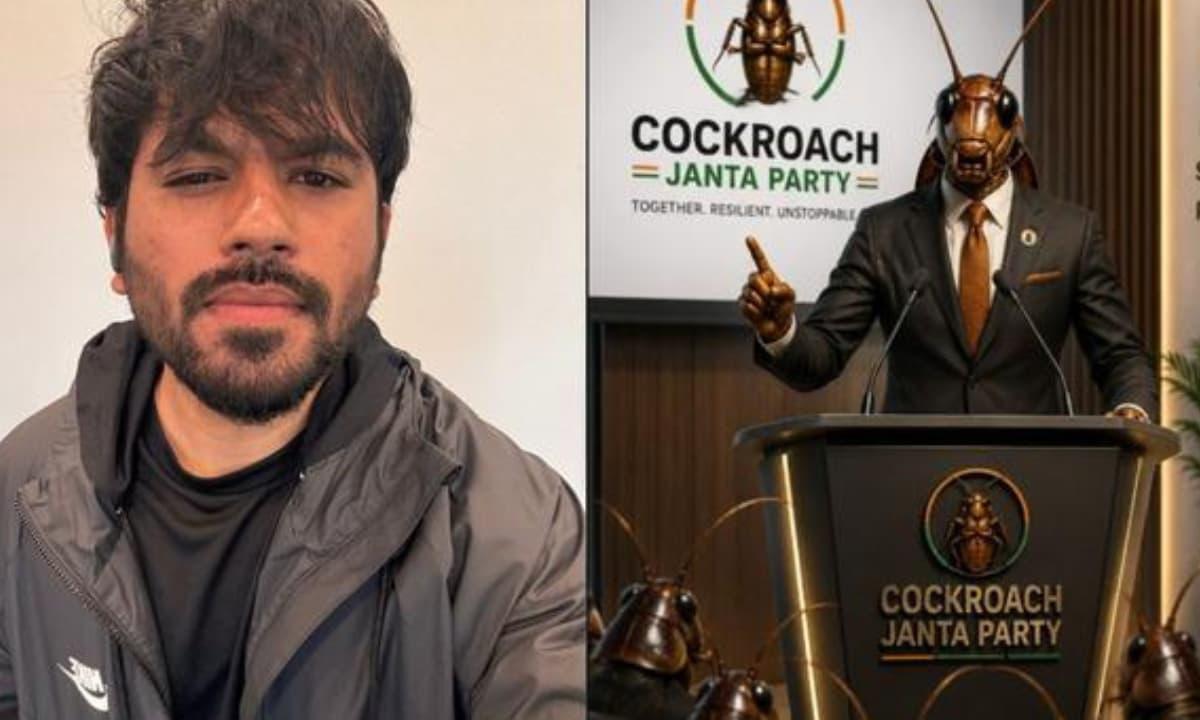
'Union Of Lazy, Unemployed Cockroaches': All You Need To Know About Cockroach Janata Party
One joke. One courtroom remark. One insect emoji.
And suddenly, millions of Indians were calling themselves "cockroaches".
What began as an internet meme this week has now snowballed into one of India's strangest - and loudest - online political moments: the rise of the "Cockroach Janata Party", or CJP, a satirical digital movement that has turned Gen Z frustration into viral political theatre.
The trigger was a controversial courtroom observation attributed to Supreme Court judge Surya Kant, where unemployed youth and activists were allegedly compared to "cockroaches" and "parasites". Social media erupted almost instantly. But instead of outrage alone, the internet chose mockery. And then, organisation.
Within hours, an X post asking, "What if all cockroaches come together?" started gaining traction. Soon after, a website appeared. Then Instagram pages. Then membership forms. Then manifestos. Then millions of followers.
The movement was launched by Abhijeet Dipke, a former social media volunteer linked to Aam Aadmi Party, who is currently studying public relations in the US. Dipke reportedly built the party's identity, graphics and manifesto using AI tools within 24 hours.
But this was not conventional politics.
The Cockroach Janata Party describes itself as a "union of lazy, unemployed cockroaches". Its tongue-in-cheek membership criteria include being "chronically online", unemployed, lazy, and capable of "ranting professionally". Its slogan? "Secular. Socialist. Democratic. Lazy."
And yet, beneath the humour sat something more serious.
For many young Indians, especially online, CJP became a way to vent years of anxiety over unemployment, exam leaks, political fatigue, shrinking opportunities and an increasingly hostile online discourse. The insect became symbolism. The meme became protest.
That may explain the staggering speed of its growth.
According to multiple reports, the party crossed millions of Instagram followers in just days - at one point even surpassing the follower count of the ruling Bharatiya Janata Party on the platform.
Prominent opposition figures such as Mahua Moitra and Kirti Azad reportedly interacted with or followed the movement online. Offline too, the meme began spilling into reality - volunteers dressed as cockroaches participated in a Yamuna cleanliness drive carrying placards and slogans.
But as CJP exploded online, suspicion followed close behind.
Critics questioned how a brand-new satirical account could gather millions of followers almost overnight. Others pointed to Dipke's past association with AAP and accused the movement of being politically engineered rather than organic. Several Reddit discussions reflected this split: some users described CJP as "refreshing" and a genuine outlet for frustrated youth, while others warned against turning meme culture into political mobilisation.
One Reddit user wrote that the movement "feels like a better alternative to reality", while another warned that "politically unaware Gen Z" could mistake satire for substance.
That tension - between parody and politics - is precisely what makes the phenomenon remarkable.
India has seen meme-driven political campaigns before. But CJP appears different because it speaks the language of internet-native frustration. Its aesthetic is deliberately absurd: cockroach graphics, self-deprecating bios, exaggerated slogans, and anti-establishment humour stitched together with meme templates and viral reels.
Yet its rise also says something uncomfortable about the state of political communication in India.
People are no longer merely consuming politics online. They are remixing it, memefying it, and turning it into participatory performance. Satire is no longer sitting outside politics; it is becoming one of its loudest dialects.
Scholars studying digital political campaigns in India have previously documented how coordinated online mobilisation can rapidly shape narratives and trends across platforms. CJP, however, adds another layer: irony as mobilisation.
Even the backlash became fuel.
Hours after reports claimed CJP's X account had been withheld in India, screenshots and hashtags only amplified curiosity around the movement.
Whether Cockroach Janata Party survives beyond the meme cycle remains uncertain. It may disappear as suddenly as it appeared. Or it may evolve into a broader anti-establishment youth platform. For now, it exists in that uniquely internet-age space between joke, protest, fandom and political experiment.
But perhaps the most striking part is this: An insult meant to belittle unemployed youth may have accidentally handed them a mascot. And in classic internet fashion, they turned it into a movement.
Popular Categories
Read More Articles
Education
Bahraich Embraces Digital Learning as “The Teacher App” Gets Grand Launch by Shamikh Rais Siddiqui May 17, 2026
Travel and Tourism
UP Bets Big On New-Age Tourism: Startups, Star Beds & A November Deadline by Awadh 360° Desk May 10, 2026
Business
Axis Bank Posts Strong 6% QOQ Growth In Deposits And Advances by Awadh 360° Desk April 26, 2026
Education
IIMC Alumni Meet Held in Lucknow, Tribute Paid to Senior Journalist by Awadh 360° Desk April 22, 2026