Why Are People Flocking to Temples as 2025 Ends?
LUCKNOW Uttar Pradesh's temples are drawing unprecedented crowds in the closing days of 2025, as people turn to spiritual spaces amid an increasingly uncertain world.
The surge in temple tourism reflects a broader search for meaning and stability. After years marked by economic pressures, global conflicts, and rapid technological change, many are seeking comfort in faith and tradition as one year ends and another begins.
"Life has become very stressful. People feel disconnected," said Dr. Anjali Mishra, a sociologist studying religious tourism patterns. "Temples offer a sense of peace that's hard to find elsewhere in our daily lives."
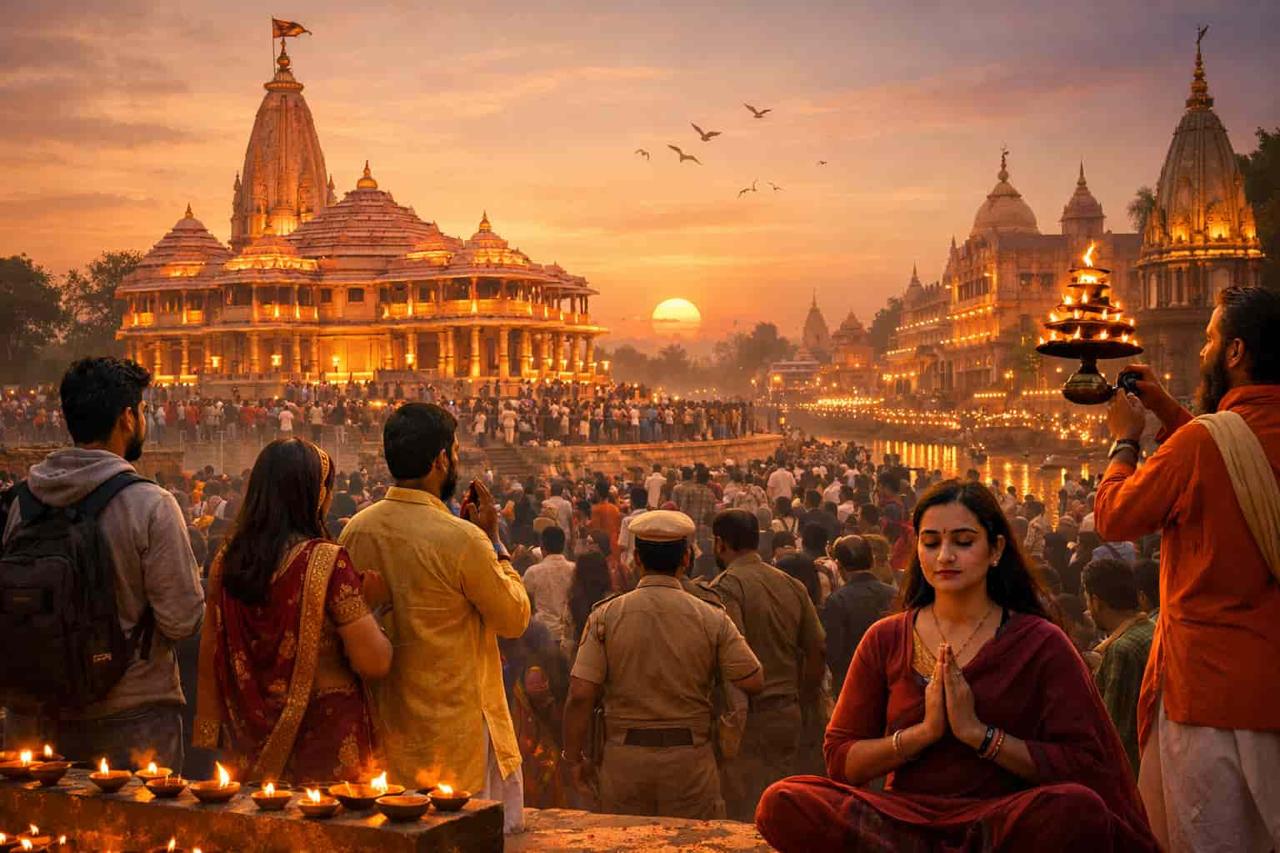
Ayodhya has emerged as the top choice for pilgrims, with footfall climbing sharply in late December. Over 2.5 lakh devotees visited on December 24 and 25 alone, with another lakh arriving by December 26 evening. The influx is expected to continue through January 1, with local authorities preparing for even larger numbers as 2026 approaches.
The phenomenon spans across the state's major pilgrimage centres. Varanasi, Prayagraj, Mathura, and Vrindavan are all reporting higher-than-usual visitor numbers, straining infrastructure and requiring additional administrative measures.
The visitors arriving at temples across Awadh come with varied concerns. Some pray for job security in a competitive market, others for family harmony in an age of digital distractions, and many simply for mental calm in a world that seems to move faster each day.
"I work in tech, staring at screens all day," said Amit Saxena, a software engineer from Bangalore visiting Ayodhya. "Coming here helps me disconnect and find some inner quiet before another hectic year begins. It's become a necessity, not a luxury."
Temple priests observe that prayers have evolved beyond traditional requests. Alongside age-old wishes for health and prosperity, devotees now seek guidance on modern anxieties—career uncertainty, social media stress, relationship challenges, and concerns about the future.
"Earlier, people asked for good harvests or safe travels. Now they pray for peace of mind, for clarity in difficult decisions, for the strength to handle workplace pressure," noted Swami Rameshwar Das at a Varanasi temple. "The language of prayer has changed with the times."
The crowds have prompted crowd management measures at major temples across the state. The Thakur Banke Bihari Temple in Vrindavan has issued an advisory requesting devotees to avoid visiting between December 29 and January 5 unless necessary, citing excessive turnout expected during the New Year period. Temple management expressed concern about ensuring safety and a proper darshan experience for all visitors.
At the Shri Kashi Vishwanath Temple, authorities have suspended "Sparsh Darshan", where devotees touch the deity, until January 3. Only "Jhanki Darshan" will be permitted, allowing visitors to view Baba Kashi Vishwanath from the sanctum sanctorum gate. The decision was made after assessing the expected crowd size and consulting with security officials.
The accommodation sector in these temple towns is experiencing a corresponding boom. Hotels, guesthouses, and dharamshalas across Ayodhya report near-full occupancy, with many establishments booked weeks in advance. Room rates have climbed, and some visitors are finding lodging in neighbouring towns.
"We haven't seen this kind of rush in years," said Ramesh Gupta, who manages a hotel near the Ram Janmabhoomi site. "Every room is taken, and we're getting calls from people willing to pay premium rates just to stay close to the temple."
The phenomenon also speaks to a post-pandemic shift in how people approach travel and spirituality. Having confronted mortality and isolation during lockdowns, many are reassessing priorities and gravitating toward experiences that promise deeper fulfilment over material pursuits or entertainment-focused holidays.
Young professionals form a notable segment of visitors, a demographic that temple administrators say was less common in previous years. Twenty-somethings and thirty-somethings are arriving in groups, often combining temple visits with stays at nearby wellness retreats or heritage properties.
"My generation is dealing with burnout, comparison culture, endless news cycles," said 28-year-old Kavya Reddy from Hyderabad. "A temple visit feels like pressing pause on all of that. It's not about being religious necessarily, it's about finding a moment of stillness."
Tourism experts say this represents a departure from purely recreational travel patterns observed in the past decade. People are choosing destinations that offer introspection and renewal rather than just sightseeing or adventure activities. The shift has implications for how the tourism industry markets religious destinations.
"We're seeing what I'd call 'purposeful travel,'" explained Nandini Sharma, a travel industry analyst based in Lucknow. "People want their trips to mean something, to leave them feeling changed or restored. Temples provide that in ways that beach resorts or shopping destinations cannot."
The timing of this surge matters too. As artificial intelligence reshapes workplaces and social media amplifies political and social divisions, the timeless rituals of temple worship provide continuity and grounding. The rhythms of prayer, the smell of incense, the sight of oil lamps—these sensory experiences offer an anchor in turbulent times.
"In a world changing faster than we can process, these sacred spaces remind us of something enduring," said travel writer Vikram Joshi, who has documented religious tourism for over a decade. "That's incredibly powerful right now, when so much feels temporary or uncertain."
The state tourism department has taken note of the trend, deploying extra personnel at major sites and coordinating with local police to manage traffic and parking. Medical teams are on standby, and temporary facilities for drinking water and restrooms have been set up at various points.
Food vendors and local businesses near these temples are also benefiting from the surge. Sweet shops are working overtime to meet demand for prasad, while souvenir sellers report brisk sales of religious items, photographs, and mementoes.
For many visitors, the journey to these temples represents more than a religious obligation. It's an opportunity to step away from routine, to reflect on the year that has passed, and to set intentions for 2026 in a space that feels sacred and removed from everyday pressures.
Popular Categories
Read More Articles

Technology
Dyson’s new Rs 47,000 toothbrush can ‘see’ between your teeth. Would you pay? by Awadh 360° Desk September 3, 2026
Politics
Seven Streams, One Goal: Inside PM Modi's 'Saptadhara' Vision To Build A Viksit Bharat by Abhishek Tandon August 30, 2026
Politics
Bankipur bypoll: More than one seat, Prashant Kishor’s first real political breakthrough by Awadh 360° Desk August 4, 2026
Education
Journey Of An AMU Student Who Became The 'Father Of Indian Molecular Biology' by Afiya Shamshad and Saud Bin Anees August 2, 2026