Budget 2026: Big Push for Orange Economy to Create 2 Million Skilled Professionals with ₹250 Cr for Animation Labs
NEW DELHI Union Finance Minister Nirmala Sitharaman on Sunday announced a ₹250-crore allocation to expand India's Animation, Visual Effects, Gaming and Comics (AVGC) talent pipeline while presenting the Union Budget 2026-27 in Parliament.
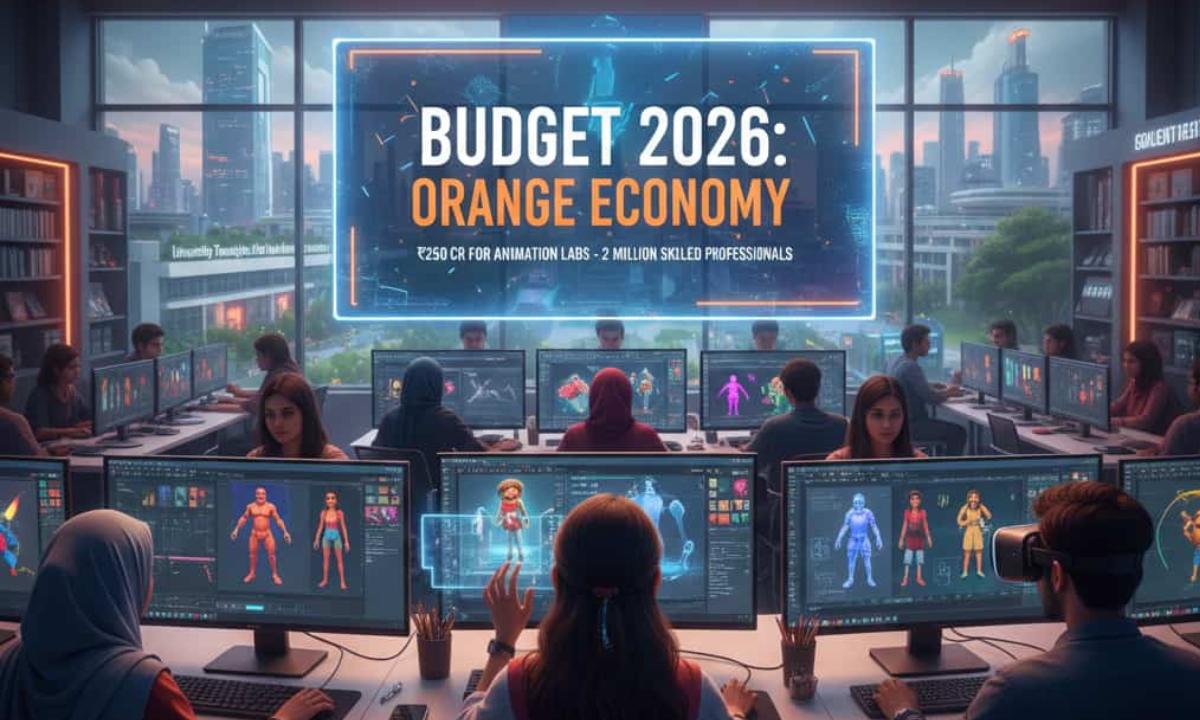
The government will support the Indian Institute of Creative Technologies (IICT), Mumbai, in establishing AVGC content creator labs across 15,000 secondary schools and 500 colleges nationwide. The initiative aims to provide early, structured exposure to animation, visual storytelling and digital content creation.
Industry projections indicate the AVGC sector will require nearly 2 million skilled professionals by 2030. The government's strategy focuses on developing talent from an early stage, extending opportunities beyond metropolitan areas to reach students across the country.
Doubling Investment in AVGC Infrastructure
The budget doubles the allocation for the National Film Development Corporation (NFDC) and the National Centre of Excellence for AVGC-XR to ₹35 crore, up from ₹17 crore in Budget 2025-26.
The ₹250-crore allocation specifically targets AVGC talent development for the fiscal year 2026-27, representing a substantial commitment to building India's creative workforce.
Content Creator Labs: Hands-On Training
The proposed labs will equip students with practical experience in animation, visual effects, gaming and comics production. The curriculum will focus on industry-relevant skills, preparing students for careers in digital media and entertainment sectors.
IICT Mumbai will oversee the lab setup and provide technical support, creating a bridge between education and employment in creative industries. The collaboration aims to ensure training standards align with industry requirements.
Students will receive opportunities for experimentation and original content creation, encouraging innovation in the creative economy. The labs will provide access to industry-standard tools and software, currently available primarily in urban centres.
University Townships Along Industrial Corridors
The Finance Minister also proposed establishing five university townships along major industrial corridors. This initiative seeks to connect education with employment opportunities, particularly benefiting creative fields where proximity to industry provides exposure to live projects and smoother transitions from education to professional roles.
For the AVGC sector, such proximity could facilitate internships, collaborative projects and direct recruitment pipelines between educational institutions and production studios.
Boosting Creative Industries
The government's focus on the Orange Economy — creative industries encompassing arts, culture, media and entertainment — reflects recognition of these sectors' economic potential and employment generation capacity. The budget represents a major push for this segment of India's economy.
The AVGC ecosystem has witnessed rapid expansion in recent years, with Indian studios securing international projects and gaming companies gaining global recognition. However, talent shortage remains a persistent challenge for industry growth.
The school and college-level infrastructure could address this gap by creating a steady pipeline of trained professionals entering the workforce annually. The nationwide reach ensures talent development extends beyond traditional creative hubs like Mumbai, Bangalore and Hyderabad.
The initiative prepares students for emerging roles in digital media, online gaming, streaming content production and virtual reality experiences. As India's entertainment and media industry expands, demand for skilled animators, game developers, visual effects artists and digital content creators continues to rise.
Implementation Details Awaited
While the budget outlines funding and scope, specific implementation timelines, lab specifications and curriculum details remain to be announced. Educational institutions and industry bodies will likely play crucial roles in executing the programme.
The selection process for the 15,000 schools and 500 colleges has not been disclosed. Equity in distribution across states and regions will be important for achieving the stated goal of extending opportunities beyond metro areas.
The budget proposals will now proceed through the parliamentary approval process before implementation begins.
Popular Categories
Read More Articles

Technology
Dyson’s new Rs 47,000 toothbrush can ‘see’ between your teeth. Would you pay? by Awadh 360° Desk September 3, 2026
Politics
Seven Streams, One Goal: Inside PM Modi's 'Saptadhara' Vision To Build A Viksit Bharat by Abhishek Tandon August 30, 2026
Politics
Bankipur bypoll: More than one seat, Prashant Kishor’s first real political breakthrough by Awadh 360° Desk August 4, 2026
Education
Journey Of An AMU Student Who Became The 'Father Of Indian Molecular Biology' by Afiya Shamshad and Saud Bin Anees August 2, 2026