Seven Streams, One Goal: Inside PM Modi's 'Saptadhara' Vision To Build A Viksit Bharat
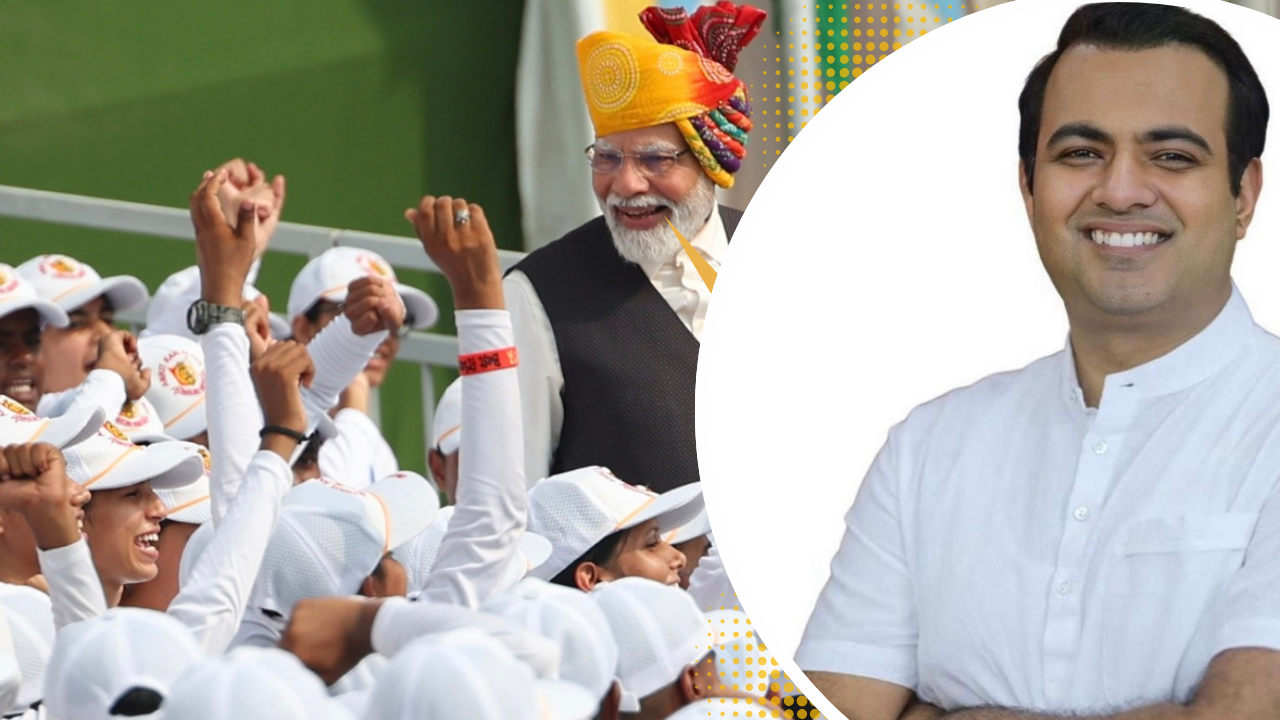
It is almost customary for Prime Minister Narendra Modi to throw one big idea into every Independence Day speech. This year, he gave us seven.
From the ramparts of the Red Fort, he laid out a new model for India to leapfrog the ladders of development: the “Saptadhara”, or seven streams. It's a callback to the Sapta Sindhu, the seven rivers that once defined the geography and imagination of ancient India. This time, the Prime Minister has reimagined those seven rivers as seven key areas where India's progress will carry the nation to the goal of Viksit Bharat.
What rivers did for civilisation centuries ago, these seven areas -- manufacturing, agriculture, technology, infrastructure, defence, the green and blue economy, and soft power -- are set to do for India's future. Not over five decades, he said, but in five to seven years.
It's a bold timeline. But it's a believable one, because on every single one of these fronts, India isn't starting from zero. It's building on a decade of results.
Stream One: Make It Here, Make It Well
In his I-Day speech, PM Modi's manufacturing pitch had a very specific undertone -- not just "make in India," but "make it well in India." He repeated the word "quality" three times in a row, almost like a mantra. The repetition wasn't an accident. India has spent years being seen as a low-cost manufacturing option. Now, the ambition is to be seen as a trusted one.
The numbers back the ambition. Morgan Stanley projects India's manufacturing sector could be worth $1.5 trillion by 2035, a scale of confidence global markets doesn’t hand out lightly. The confidence is already being earned on the ground: India's factories, MSMEs and component makers have spent the last decade building exactly the kind of skilling pipelines, testing infrastructure and design capability that zero-defect, global-standard manufacturing demands. The foundation isn't a future promise -- it is already being poured, brick by brick, and the Saptadhara vision simply gives it a clear finish line to run toward.
Stream Two: From Farm to the World's Table
Foodgrain production touched a record 357.73 million metric tonnes, and horticulture output crossed 362 million tonnes. Agricultural exports climbed to $54.70 billion. PM Modi also spoke about shrimp exports crossing new highs -- India's frozen shrimp shipments hit a record Rs 49,037.93 crore this past financial year, making up two-thirds of the country's total seafood earnings.
The pivot to chemical-free farming is where this story gets even better. Global demand for it is enormous, and Indian farmers are already answering the call -- natural and organic farming acreage has been expanding year on year, supported by government schemes that make the transition easier, not harder. What was once a niche practice is fast becoming a mainstream movement, and it's putting India in a rare position: a country that can feed the world and do it the clean way.
Stream Three: From Market to Maker
This is arguably the sharpest line in the whole speech: India should stop being just a market for technology and start being where technology is made. UPI is the proof of concept everyone points to -- a payments system so good that other countries now want to copy it. India also climbed to 38th place on the Global Innovation Index, a real, measurable jump.
The same playbook is already being repeated in AI, quantum computing and homegrown 6G. India has built research missions, semiconductor incentives and a genuinely deep talent pool in exactly these fields -- the same ingredients that turned UPI from an idea into a global export. The country that built the world's most-used digital public infrastructure from scratch is more than capable of doing it again at the frontier of emerging technology, and the groundwork for that is already underway.
Stream Four: Getting From Here to There, Faster
Logistics may be less flashy than AI or defence exports, but it's the quiet backbone that makes everything else work. Faster ports, better highways, integrated logistics -- these are what let a product be globally competitive instead of losing out to shipping delays. PM Gati Shakti Yojana has already transformed our logistics. As a consequence, India's logistics ranking has climbed to 38th place on the World Bank's index, a jump that reflects years of investment in highways, dedicated freight corridors and modern ports.
This climb is picking up speed, not slowing down, and it's exactly the kind of infrastructure push that turns manufacturing and agricultural ambition into goods that actually reach the world on time.
Stream Five: Standing on Its Own Two Feet
Defence is where PM Modi's message carried the most urgency. "Bharat cannot simply remain a market for the world" wasn't just a line -- it reflects how the world has changed. Countries are increasingly protecting their own interests first, and India, he argued, cannot be caught depending on others for its security.
Here, the data is genuinely strong. India now ranks 4th globally in military strength. Domestic defence production hit a record Rs 1.78 lakh crore, and Indian-made defence equipment now reaches over 80 countries. The kind of export footprint doesn't happen without real technological depth already in place -- which is exactly why India's push into drones, counter-drone systems and hypersonic capability sits on such solid ground. The country has already proven it can go from importer to exporter; the next leap, to next-generation defence technology, builds directly on that proven strength.
Stream Six: Green, Blue, and Genuinely Growing
The green and blue economy is where India's story is quietly compelling. The Blue Economy -- fisheries, ports, coastal tourism, ocean resources -- already contributes close to 4% of GDP. India is now the world's second-largest fish producer, with output nearly doubling to 195 lakh tonnes, and that industry supports close to 30 million livelihoods.
Green hydrogen and renewable energy are moving at an equally impressive clip. India has already become one of the fastest-growing large renewable energy markets in the world, and the same policy momentum that turned the blue economy into a genuine GDP contributor is now being channelled into green hydrogen, energy storage and green manufacturing. Two oceans of opportunity, both flowing in the same direction.
Stream Seven: The Power Nobody Can Tax
Soft power might be the hardest stream to measure, but it may end up being the most durable one. Yoga has genuinely gone global. Indian cinema keeps finding new audiences -- RRR became a worldwide talking point a few years ago, and more recently, Dhurandhar: The Revenge broke into North America's top three at the box office. The government's WAVES Summit is India's attempt to formalise this into an actual industry, not just a cultural export that happens by accident.
Soft power compounds slowly, but it also sticks. A country people love watching, visiting and trusting culturally often finds it easier to sell everything else too.
So, Does It Add Up?
Here's the honest picture: it does, and the receipts are already in hand. Agriculture, defence and the blue economy are not just promising streams -- they're delivering record numbers today. Manufacturing and Gati Shakti are riding a decade of infrastructure and industrial investment that is now visibly compounding. And even the most futuristic streams, deep tech and the green economy, are backed by the same institutional muscle and policy follow-through that has already turned earlier ambitions -- UPI, the blue economy, defence exports -- into global success stories.
The Saptadhara framing doesn't ask India to imagine a future from scratch. It takes seven areas where the groundwork is already laid and points them, together, at one shared horizon. This clarity of direction, backed by a decade of proof that this leadership delivers on what it promises, is exactly what turns a vision into a timeline.
Rivers reach the sea because they keep flowing -- and these seven already are. The next five to seven years won't be a test of whether India can build momentum. They'll be a showcase of how far that momentum, already in motion, can carry the country.
India has picked its direction. It is already moving, and under this vision, it will move faster still.
{The writer is State Secretary, Delhi, BJP and Professor at University of Delhi.}
Popular Categories
Read More Articles
Politics
Munich Comes To Delhi: India's Seat At The Global High Table by Abhishek Tandon October 14, 2026
Education
CSR initiatives give Bahraich govt schools an infrastructure boost by Awadh 360° Desk October 5, 2026
Technology
Dyson’s new Rs 47,000 toothbrush can ‘see’ between your teeth. Would you pay? by Awadh 360° Desk September 3, 2026
Politics
Bankipur bypoll: More than one seat, Prashant Kishor’s first real political breakthrough by Awadh 360° Desk August 4, 2026